
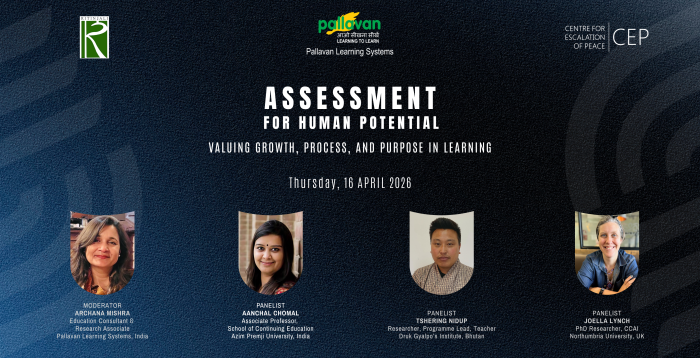
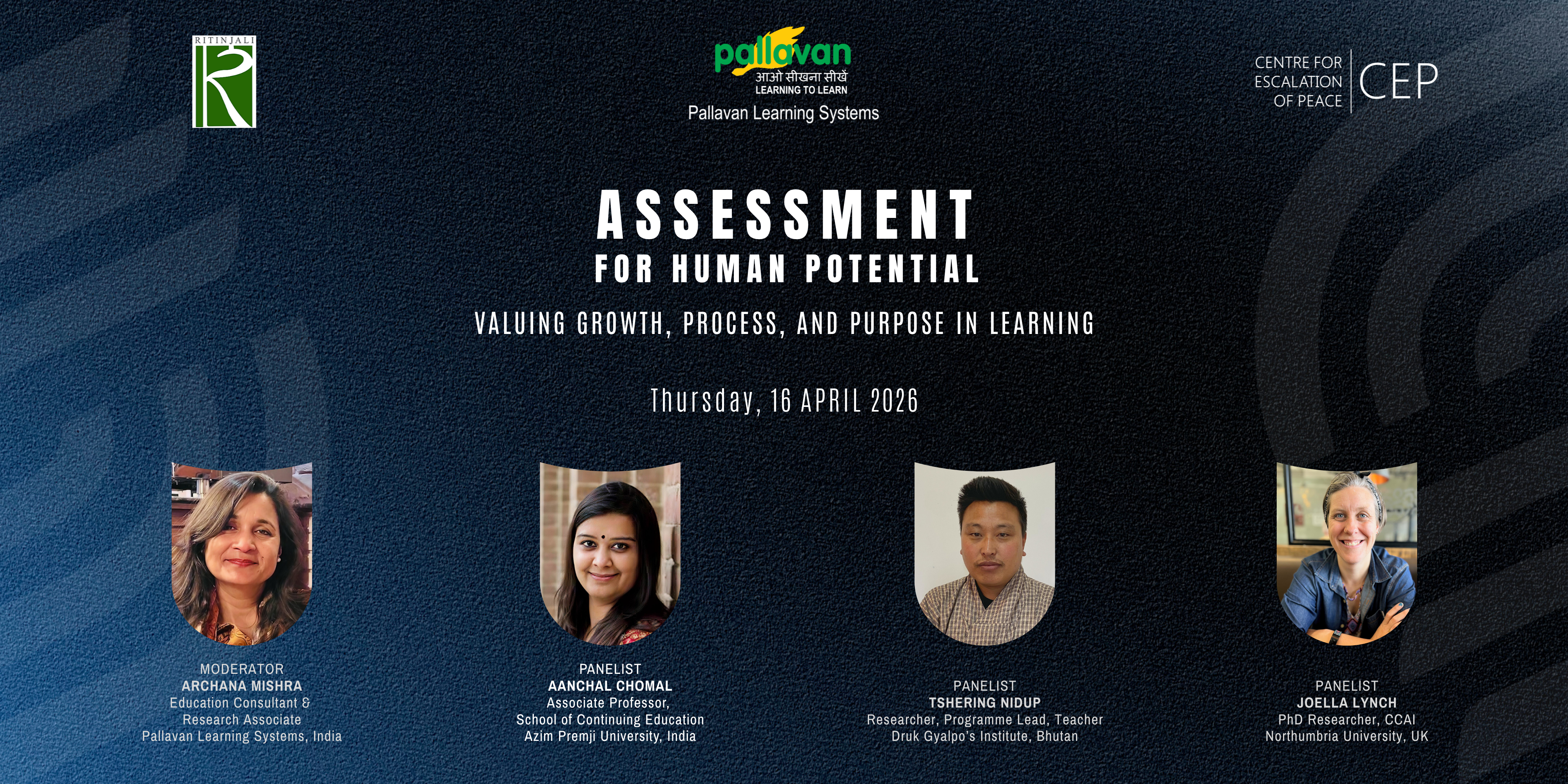
Assessment for Human Potential: Valuing Growth, Process, and Purpose in Learning
On 16 April 2026 Pallavan Learning Systems hosted a webinar on the theme, ‘Assessment for Human Potential: Valuing Growth, Process, and Purpose in Learning' in association with Centre for Escalation of Peace and Ritinjali.
What if the most valuable qualities in a learner cannot be captured through marks, grades, or rankings?
This thought-provoking webinar brought together diverse international perspectives to challenge the way assessment is commonly understood and practised. Moving beyond the narrow focus on scores and performance, the conversation explored how assessment can become a powerful tool for growth, reflection, and the development of human potential.
A central theme of the webinar was the widening gap between what traditional assessments measure and what truly matters in life. While examinations may capture recall, speed, and test performance, they often overlook qualities such as curiosity, resilience, empathy, integrity, courage, creativity, and the ability to adapt. These are the qualities that shape meaningful lives, responsible citizenship, and long-term success. The discussion encouraged participants to rethink whether current systems are measuring what is easiest to quantify rather than what is most important to cultivate.
Rather than seeing assessment as a final verdict or judgment, the webinar highlighted the need to view it as an ongoing process that helps learners understand where they are, where they need support, and how they can grow. When used well, assessment can make learning visible, guide next steps, build confidence, encourage reflection, identify strengths and gaps, and deepen understanding. This shift from assessment of learning to assessment for learning emerged as one of the strongest messages of the session.
In a world where artificial intelligence can generate essays, solve problems, and perform strongly on standardised tests, the webinar raised an urgent question: what should education now prioritise?
If machines can replicate many measurable tasks, then schools must focus even more intentionally on distinctly human capacities—critical thinking, ethical judgment, creativity, collaboration, emotional intelligence, and the ability to learn continuously. Assessment systems, therefore, must evolve to recognise these deeper dimensions of learning.
Another key idea explored was the importance of helping learners take ownership of their progress. Strong assessment systems do not rely only on external judgment. They also help students reflect on their own growth, recognise their challenges, and set meaningful goals. When learners are involved in assessment, they move from being passive recipients of grades to active participants in their own development. This creates stronger motivation, deeper engagement, and habits that support lifelong learning.
The webinar also stood out for its high level of audience engagement. Questions were regularly posed to participants through the chat, prompting reflection and encouraging them to share their own perspectives and experiences. The responses added richness to the discussion, with participants contributing thoughtful insights on self-assessment, learner ownership, trust, and the wider purpose of education. This interactive element turned the session into a genuine dialogue rather than a one-way panel discussion.
The webinar also emphasised that no assessment reform can succeed without the right culture. Trust between teachers, learners, schools, and families is essential. Where fear, comparison, and excessive pressure dominate, assessment can become disabling. Where trust, dialogue, and support are present, assessment can become transformative. Parents were also recognised as important partners in this shift. Bringing families into conversations about growth, wellbeing, and broader success can help move communities beyond the sole pursuit of marks.
This webinar was not an argument against exams. It was an invitation to think more deeply about the purpose of education itself. If education is meant to help young people become thoughtful, capable, compassionate, and resilient human beings, then assessment must do more than rank and sort. It must help learners flourish.
Explore the full report for deeper insights from the session. Click here to read or download, and watch the recording here.
Moderator:
Archana Mishra, Education Consultant & Research Associate, Pallavan Learning Systems, India
With over 30 years of experience teaching national and international curricula across schools in India and Bhutan, including The British School, Druk Gyalpo Institute, and The Shri Ram School, Archana is a dedicated educator, administrator, and lifelong learner. She has consistently focused on centring student learning experiences and integrating technology into pedagogical practices, thereby creating personalised and evolving learning environments. Known for her innovative approaches, Archana has set the standard in areas such as technology integration within the Science curriculum, experiential learning, and inclusive teaching. Currently serving as a Science consultant and Research associate at Pallavan Learning Systems, she empowers educators to incorporate experiential learning, ensuring that teaching is both relevant and engaging for students.
Panelist:
Aanchal Chomal, Associate Professor, School of Continuing Education, Azim Premji University, India
Aanchal Chomal is an Associate Professor at the School of Continuing Education and University Resource Centre at Azim Premji University, where she also heads the Assessment team. In addition, she leads the Field Research function at Azim Premji Foundation. She has worked extensively in the field of education across India, with particular focus on student assessment, teacher evaluation, and frameworks for measuring learning in both cognitive and socio-emotional domains.
Over the years, she has conducted content and pedagogic workshops with government school teachers, teacher educators, and education functionaries across several states in India. Her work has included areas such as learning outcomes, test design, formative assessment, and social science education. She has also worked closely with institutions such as the Government of Karnataka, CBSE, NCERT, NCTE, UNESCO, and the Ministry of Education on assessment-related initiatives and policy development.
Aanchal holds a Bachelor’s degree in Geography from Presidency College, Kolkata, and a Master’s degree in Geography from Jawaharlal Nehru University, New Delhi.
Panelist:
Tshering Nidup, Researcher, Programme Lead, Teacher, Druk Gyalpo’s Institute, Bhutan
Tshering works as a researcher with the Druk Gyalpo’s institute and also teaches Life Science at The Royal Academy. His areas of interest in education include capturing wholistic growth by widening the lens of assessment and reporting as well as education policies and their impact on learning.
He has also provided leadership in numerous programmes in teacher professional development related to the Bhutan Baccalaureate.
Panelist:
Joella Lynch, PhD Researcher, CCAI, Northumbria University, UK
Joella Lynch is a PhD researcher in Citizen-Centred Artificial Intelligence at Northumbria University, UK, exploring how teachers make professional decisions about whether, when, and how to use AI in education. Her research focuses on the role of teacher judgement, educational purpose, and meaningful learning in an age of rapidly evolving technologies.
Before beginning her PhD, Joella worked as a secondary school science teacher in the UK and has been involved in a range of educational initiatives including Skills Builder programmes and The Brilliant Club. She has also worked internationally, including teaching at the Druk Gyalpo’s Institute in Bhutan, where she developed a strong interest in education systems that prioritise holistic development and human potential.
Through her research and workshops with educators, Joella explores how emerging technologies such as AI can support learning while still preserving the deeper aims of education—curiosity, critical thinking, creativity, and human flourishing. Her work brings together perspectives from education, human-centred AI, and teacher professional practice.
To receive regular updates, subscribe to our Pallavan World and PLS Newsletter.
Should you have any feedback and suggestions, please feel free to share with us.