
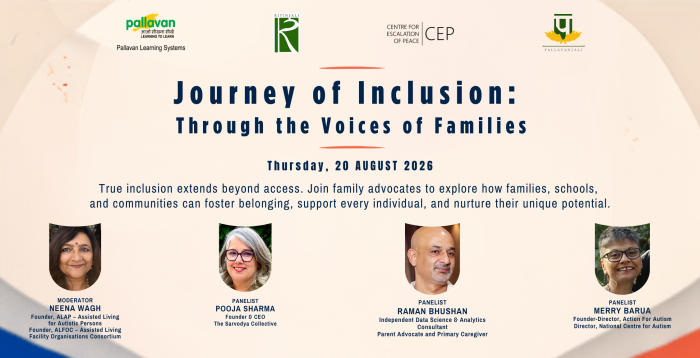
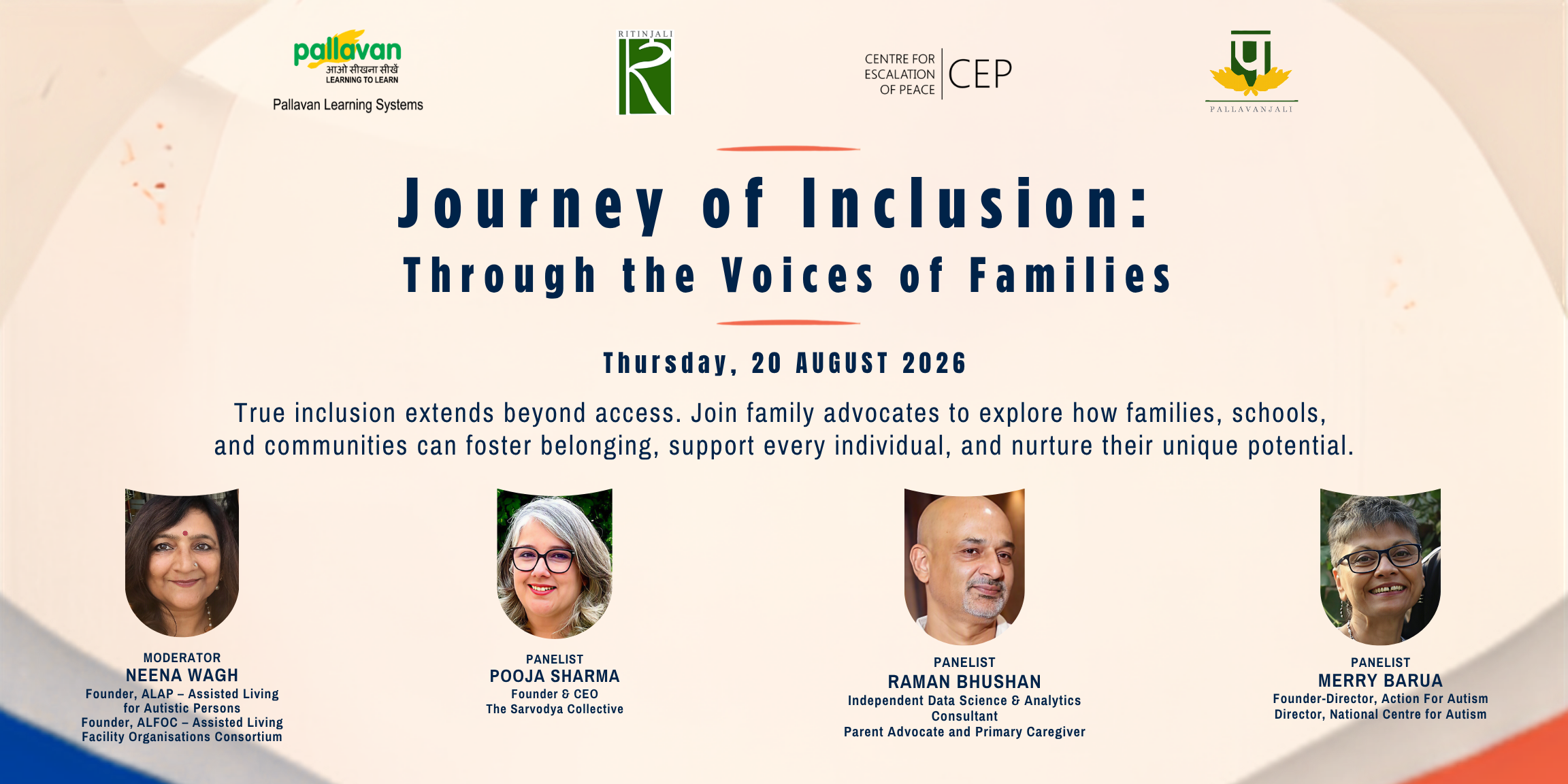
Journey of Inclusion: Through the Voices of Families
Pallavan Learning Systems, in collaboration with Centre for Escalation of Peace, Ritinjali and Pallavanjali, organised the webinar “Journey of Inclusion: Through the Voices of Families” on 20 August 2026. The webinar brought together family advocates representing different lived experiences of disability: a mother and long-standing autism advocate, a father and single parent of a daughter with cerebral palsy, and a sibling of an adult with an intellectual disability.
The session approached inclusion through the experiences of families rather than only through institutional policies or professional practice. It recognised the family as the first unit of society and the first system of care and support available to an individual. The session opened by reflecting on how the strength and well-being of families influence society as a whole. When families are adequately supported, individuals are better placed to thrive; when families supporting persons with special needs struggle, those pressures are eventually reflected in the wider social system. The discussion therefore asked how far society has travelled towards inclusion, where the gaps remain, and how families, institutions and communities can collectively work towards narrowing them.
The webinar moved across the life course, beginning with diagnosis and early acceptance and extending to family relationships, caregiving, schooling, adulthood, employment, healthcare, advocacy and long-term support. The personal experiences shared during the session illustrated that inclusion is not achieved at a single moment. The needs of individuals and families continually evolve, requiring systems and communities to evolve alongside them.
A recurring theme was that inclusion must extend beyond physical presence. Being admitted to a school, being offered an internship or being permitted to enter a public space does not automatically create belonging. Meaningful inclusion requires institutions and communities to recognise individual agency, understand different needs and create opportunities for participation, dignity and purpose.
Explore the full report for deeper insights from the session. Click here to read or download, and watch the recording here.
Moderator:
Neena Wagh, Founder, ALAP – Assisted Living for Autistic Persons, Founder, ALFOC – Assisted Living Facility Organisations Consortium
Neena Wagh is a parent, advocate, and changemaker who has been actively involved in autism advocacy for over two decades. As the mother of a 26-year-old son on the autism spectrum, her work has been shaped by lived experience and by the question, “What after us?”
Driven by the need to create sustainable support systems for autistic adults, she founded ALAP – Assisted Living for Autistic Persons, which focuses on supported living solutions for young adults on the autism spectrum. Recognising the need for greater structure, collaboration, and standards within the assisted living sector, she also founded ALFOC – Assisted Living Facility Organisations Consortium, bringing together organisations working in this space across India.
Neena is a regular speaker and writer on inclusion, disability rights, and the rights of persons with disabilities. Alongside her advocacy work, she is also a poet, playwright, and Hindi translator.
Panelist:
Pooja Sharma, Founder & CEO - The Sarvodya Collective
Pooja Sharma is the Founder and CEO of The Sarvodya Collective, an organisation working to build informed, enabling, and inclusive communities around persons with intellectual and developmental disabilities in India. Drawing on her lived experience as a sibling, she focuses on cultivating active allies across schools, workplaces, and communities, and on shifting attitudes from awareness towards deeper acceptance and meaningful inclusion.
Before founding The Sarvodya Collective, Pooja spent over a decade working in corporate strategy and portfolio management with organisations including Pearson plc and Central Square Foundation. She has also served as a trustee of The Bell Foundation, as a school governor, and in advisory roles with social impact organisations.
Her work is grounded in the belief that inclusion is shaped not only by policy, but through everyday choices that enable people to be seen, accepted, supported, and included as equal members of society.
Panelist:
Merry Barua, Founder-Director, Action For Autism, Director-National Centre for Autism
Merry Barua is an activist, special educator, parent advocate, and one of the pioneers of the autism movement in India. She began her work at a time when awareness, understanding, and support for autism were extremely limited, and has since played a significant role in advancing autism awareness, education, diagnostics, training, advocacy, and policy in the country.
As Director of Action For Autism, Merry has worked extensively with autistic individuals, families, educators, and professionals, helping to strengthen services and support systems while encouraging the growth of parent-led initiatives across India. She is also a writer, teacher, trainer, counsellor, and advocate, and is an Ashoka Fellow.
Her work reflects a longstanding commitment to building an inclusive society that challenges narrow definitions of “normal” and recognises the rights, strengths, individuality, and potential of autistic persons. She has received national and international recognition for her contribution to the field.
Panelist:
Raman Bhushan, Independent Data Science & Analytics Consultant, Parent Advocate and Primary Caregiver
Raman Bhushan is the primary caregiver to his daughter with cerebral palsy, and his lived experience as a parent has shaped his understanding of care, development, dignity, and quality of life. His primary focus has been on supporting his daughter’s development and creating the conditions that enable her to lead a meaningful and fulfilling life.
Professionally, Raman is an independent consultant with close to 30 years of experience in functional and business leadership roles across analytics and data science. He has extensive experience in designing and implementing data science solutions for leading global and Indian corporations, as well as government and social sector organisations.
Raman brings together his professional experience and personal journey as a caregiver.
To receive regular updates, subscribe to our Pallavan World and PLS Newsletter.